
Adapting to the Terrain: Wild Boar in Hong Kong

Airport wildlife hazard management is often thought of as a bird problem, but the risks on the ground can be just as significant. Wild boars are large, unpredictable, and capable of causing serious damage to aircraft, vehicles, and infrastructure, making them a growing concern for airport operators managing wildlife strikes and incursions. Mastermark is the Asian distributor for Pig Brig, widely regarded as the best wild boar trap on the market. We became the distributor after first using the product ourselves, and our firsthand success in the field gave us complete confidence in recommending it to others.
Hong Kong is one of the few places where dense urban development sits directly alongside extensive country parks. As a result, encounters between people and wild boars have become a regular part of daily life, creating unique challenges for wildlife managers.
Recently, I had the opportunity to work alongside my colleagues, Jason Tong and Victor Ng, to deliver a three-day Wild Boar Management and Pig Brig Trap training programme for the Agriculture, Fisheries and Conservation Department (AFCD) of Hong Kong.
Day 1: Understanding the Challenges
The training began with two classroom sessions held at AFCD Headquarters and the Fauna Conservation Division. The discussions were highly engaging, with staff asking thoughtful questions throughout the presentations. Each session naturally evolved into an extended discussion, reflecting the team's strong interest in improving current management practices.
One operational issue quickly became apparent during these conversations: veterinary resources are extremely limited. At present, only two veterinarians support wild boar operations across Hong Kong and its surrounding islands.
This shortage often delays the response after animals are captured. The longer wild boars remain in traps, the greater the likelihood of escapes, reducing the overall effectiveness of trapping operations.

To help address this challenge, we introduced a practical blowpipe familiarisation session. The objective was to give officers hands-on exposure to another field technique that could support future operations, particularly in situations where veterinary assistance cannot arrive immediately.
Days 2 & 3: Tackling the Terrain at Shek O
The remainder of the training was conducted at Shek O Country Club, where we were joined by both AFCD officers and the club's staff.
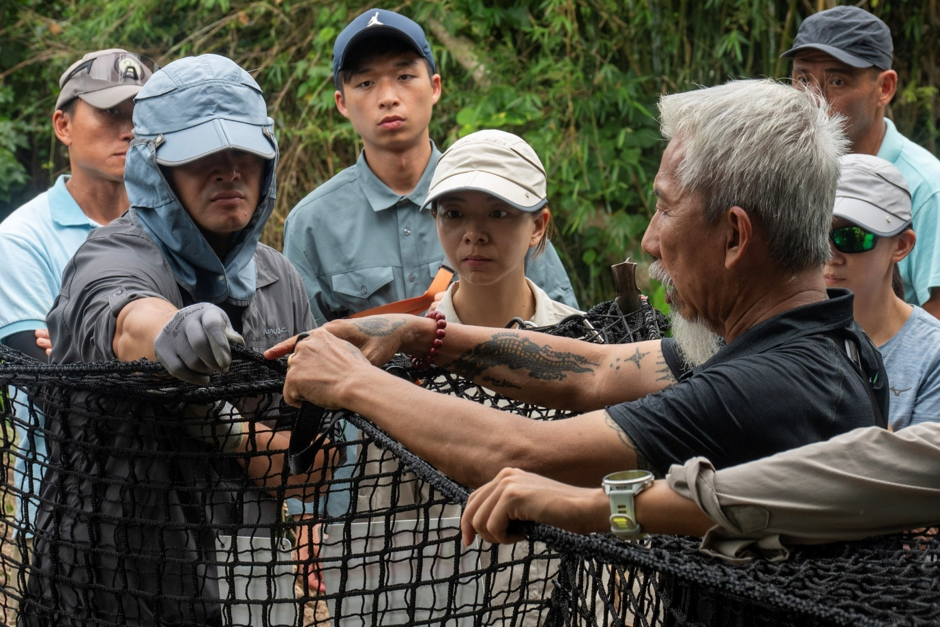
Field conditions quickly demonstrated why wildlife management in Hong Kong presents unique operational challenges. Much of the landscape is steep, uneven and covered with exposed rock, making it difficult to deploy conventional rigid trapping systems. Heavy steel traps are not only difficult to transport into these locations, but are also challenging to install securely on irregular ground.
These conditions highlight the advantages of the Pig Brig Trap System. While the system is highly adaptable, successful deployment still depends on understanding the site and making the necessary adjustments for local conditions.
During the field sessions, we focused on three key features of the system.
The first was its ability to capture an entire sounder. Unlike traditional cage traps that close after a single trigger, the Pig Brig uses a continuous-entry design that leverages pigs' natural rooting behaviour. This allows multiple animals from the same group to enter before removal, making population management significantly more effective.
Secondly, we examined its adaptability to difficult terrain. Because the system is lightweight and flexible, it can be carried into remote locations without machinery or extensive site preparation. This makes it particularly well-suited to the rocky hillsides and forested landscapes commonly found throughout Hong Kong.
Finally, we discussed animal welfare considerations. The Pig Brig uses knotless netting that cushions impact and reduces the risk of injuries when animals move within the enclosure. Compared with conventional metal traps, this design helps minimise stress during containment.
Working closely with the AFCD officers and the Shek O Country Club team, we demonstrated several modifications to improve trap performance on uneven, rocky ground where standard anchoring methods may not be suitable.

Recognising that the delayed retrieval of captured animals is sometimes unavoidable, we also placed considerable emphasis on preventing escapes. This included reinforcing the netting, improving ground contact, and adjusting installation techniques to reduce opportunities for animals to lift or dig beneath the trap.
Learning from One Another
One of the most rewarding aspects of the programme was the opportunity to exchange knowledge with the AFCD team. Their professionalism and willingness to learn were evident throughout the three days.

Beyond the technical aspects of trap deployment, we spent time discussing site selection, animal behaviour, and practical decision-making in the field. While we shared our experience with the Pig Brig system, the AFCD officers contributed valuable local knowledge about Hong Kong's wild boar populations, terrain, and operational constraints.
It reinforced an important point: effective wildlife management is never simply about applying a standard method. Success depends on understanding local conditions and adapting techniques to suit the environment.
Looking Ahead
Managing wild boars in a city as densely populated as Hong Kong requires balancing public safety, animal welfare, and operational efficiency. Every location presents its own set of challenges, and practical solutions often come from adapting proven methods to local realities.
By improving field techniques, addressing operational constraints, and making full use of adaptable trapping systems, we can continue to strengthen wild boar management programmes while maintaining high welfare standards.
A sincere thank you to the AFCD team and the staff of Shek O Country Club for their warm hospitality, enthusiasm throughout the training, and commitment to conserving Hong Kong's unique natural environment. It was a pleasure to work alongside such a dedicated group of wildlife professionals.


Comments